

Big Boy Exotics serves exotic-car buyers across the United States. Tell us about your car search.
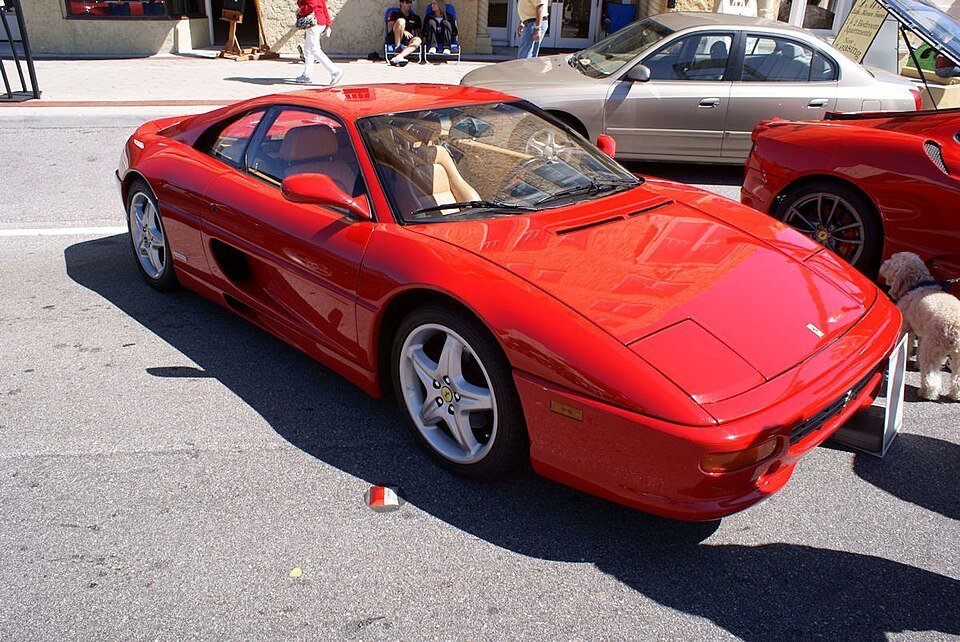
Cover: Ferrari 355 F1 Berlinetta, front-right view, Valder137; CC BY 2.0. Wikimedia resize; otherwise unchanged. Illustrative reference photograph. Compact-delivery image resized and JPEG-compressed; no cropping or content edits.

The 355 F1 Berlinetta is often introduced through its gearbox. That is understandable: the steering-wheel paddles marked an important moment for Ferrari road cars. Yet the engine they serve deserves equal attention. Understanding the five-valve V8 gives a prospective owner a clearer idea of what makes this generation distinctive.
Ferrari dates the 355 F1 Berlinetta’s unveiling to the 1997 Frankfurt Motor Show. It developed from the F355 Berlinetta introduced three years earlier, retaining the central idea of a compact, high-revving V8 sports car while adding electrohydraulic control of gear selection.
Breathing was the engineering priority
In its F355 retrospective, Ferrari describes a 3.5-liter engine with five valves per cylinder, titanium connecting rods, forged-alloy pistons, a flat-plane crankshaft and dry-sump lubrication. The valve arrangement was intended to improve the engine’s breathing.
These features form a useful explanation of the design, rather than a list of collectible buzzwords. An engine must move air in and exhaust out repeatedly as its speed rises. Valve area, moving mass and lubrication all matter to the conditions in which it can do that work. Ferrari pursued those demands as part of a coordinated engine program.
For the original F355 Berlinetta, the manufacturer’s technical record places peak power at 8,250 rpm. That historical reference helps explain the family’s reputation for an engine that rewards deliberate gear selection. It should not be treated as an instruction to seek maximum revs during a purchase inspection.
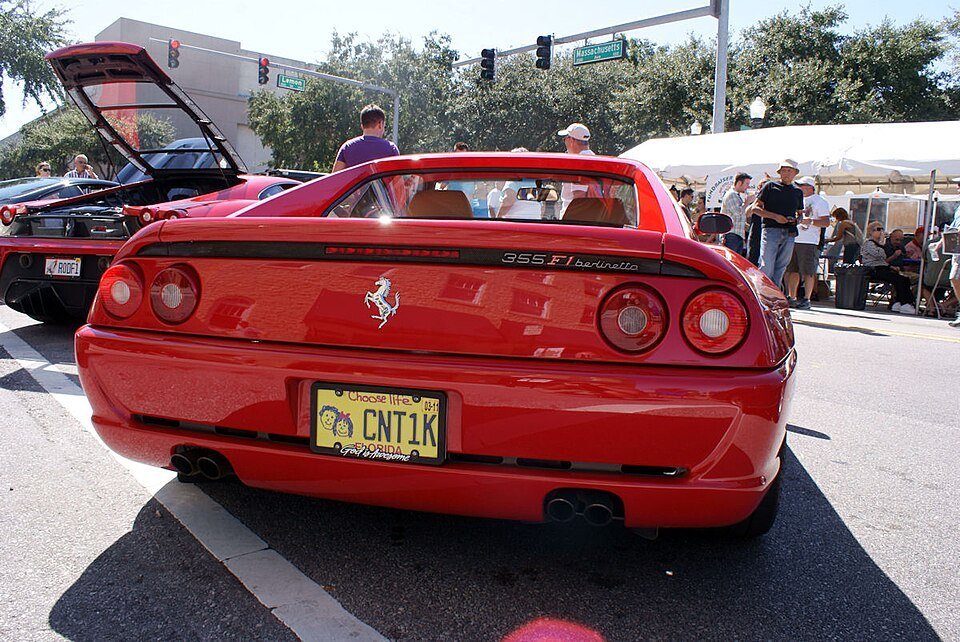
Photo: Ferrari 355 F1 Berlinetta, rear view, Valder137; CC BY 2.0. Wikimedia resize; otherwise unchanged. Illustrative reference photograph. Compact-delivery image resized and JPEG-compressed; no cropping or content edits.

Keep the engine and transmission questions distinct
The F1 system added a different way to interact with the driveline. Ferrari’s historical account describes an electrohydraulic mechanism and control software operated through two steering-wheel levers. The driver’s choice of ratio remained a meaningful part of the experience.
When evaluating a car, separate what you like about that interaction from questions about its mechanical condition. Does the paddle arrangement suit you? Are you comfortable with the timing and involvement of selecting gears? Those are preference questions. Hesitation, warnings or inconsistent behavior require assessment by a technician familiar with this system.
Arrange enough time for the specialist to observe the car under ordinary operating conditions. Ask for the relevant engine and transmission findings in writing, with any recommended work explained. A brief video of an enthusiastic acceleration run gives little context for interpreting the state of either system.
Protect the character you are buying
A used example may have accumulated changes to its exhaust, intake or control software. Before deciding whether those changes suit your priorities, establish what is fitted and how it differs from the documented build. Sound alone cannot establish whether a modification was appropriate or whether the underlying engine is healthy.
Request invoices that identify the work, its date and mileage, and the shop responsible. Have the inspecting technician explain the remaining maintenance requirements using the correct documentation for that specific car. Generic statements about a model’s reputation are less useful than evidence about the example in front of you.
For a US purchase, put the initial maintenance estimate, transport arrangements and local service support alongside the acquisition budget. Specify whether you are seeking an original configuration or accepting documented changes, and make that choice before comparing asking prices.
The 355 F1 Berlinetta combines an important driver interface with an engine that was already a substantial technical achievement. Appreciating both makes for a more precise search and a more satisfying understanding of the car once it arrives.
From the Journal
Ferrari Testarossa: What the Side Strakes Tell a US Buyer
Looking for a particular exotic car? Start your private search with Big Boy Exotics or send your car-sourcing brief to info@bigboyexotics.com.