
Big Boy Exotics helps buyers source exotic cars across the United States. Tell us about your car search. The BBE Journal also explores the details that make mechanical watches rewarding to own.
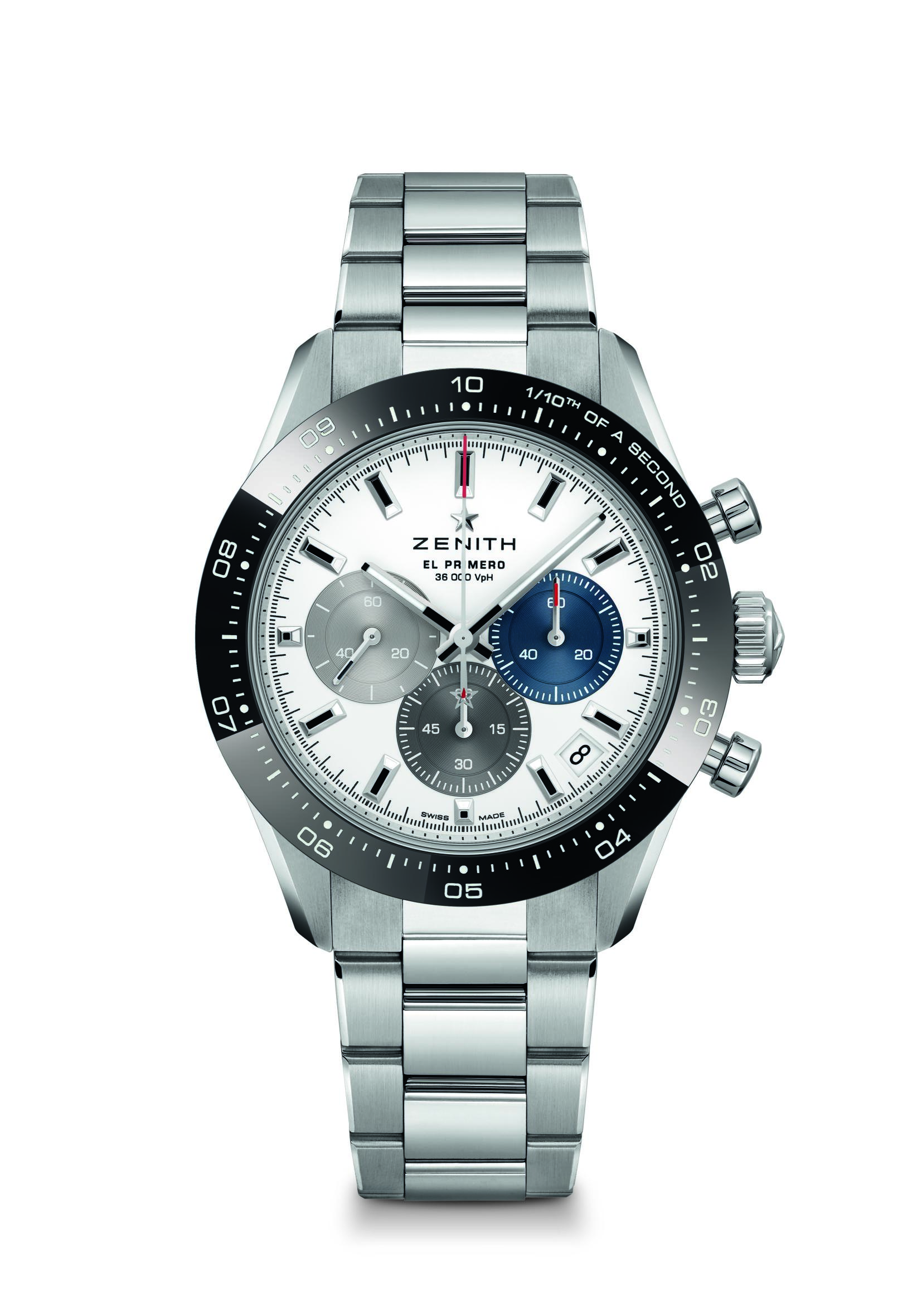
Zenith Chronomaster Sport, reference 03.3100.3600/69.M3100. Photo: 03.3100.3600.69.M3100.jpg by Zenith Japan / Wikimedia Commons; CC BY-SA 4.0. Original photograph used unchanged.

The Zenith Chronomaster Sport makes its unusual character visible as soon as the chronograph starts. Its central timing hand circles the dial in ten seconds. Learning to read that fast-moving hand is a better introduction to the watch than treating its black bezel as familiar sports-chronograph decoration.
This guide focuses on the white-dial steel reference 03.3100.3600/69.M3100. Zenith introduced the Chronomaster Sport on January 22, 2021. For a US collector comparing pre-owned examples, its established design offers a distinctive way to read elapsed time.
Give each hand a job
Zenith’s Chronomaster Sport operating diagram distinguishes three subsidiary displays within the El Primero 3600 layout. The small seconds at nine o’clock belong to ordinary timekeeping. The counter at three records chronograph seconds, while the counter at six records elapsed minutes, up to a full 60-minute revolution.
Zenith explains that the El Primero 3600 sends its central chronograph hand around the dial every ten seconds, with tenths read against the bezel. A stopped central hand therefore does not tell you the whole duration once an interval passes ten seconds. The other counters supply the larger units.
Try a hypothetical reading: one completed minute, 23 elapsed seconds and a central hand at 3.4 on the bezel. That means one minute, 23.4 seconds. The three in 3.4 repeats the units digit already included in 23; it should not be added a second time. Ask a retailer to demonstrate a few stopped readings until combining the displays feels natural.
Understand what high frequency promises
The manual’s El Primero 3600 section specifies 36,000 vibrations per hour, or 5 Hz. Dividing by 3,600 gives ten vibrations each second. That rhythm underpins the movement’s tenth-of-a-second chronograph display.
Keep the display’s resolution separate from the watch’s daily timekeeping performance. A scale marked in tenths is not a promise that the watch gains or loses only a tenth of a second per day. Likewise, manually starting a stopwatch introduces your own timing judgment. Enjoy the mechanical indication without treating a casual wrist-timed interval as laboratory evidence.
Practice the controls in order
Zenith’s operating instructions, page 23 describe the sequence: use the upper pusher to start and stop, then the lower pusher to reset after stopping. The upper pusher can also resume a paused measurement. Obtain the instructions appropriate to the actual watch before changing its time or date.
During a viewing, ask the seller to demonstrate those functions and the return to zero. Read a short interval, then one longer than a minute. Observe the dial under ordinary indoor lighting and at your normal wrist distance. Enlarged listing photographs can make fine graduations seem easier to use than they feel in daily life.
Make the demonstration part of the purchase
A successful stopwatch demonstration gives you a useful experience of the controls. Authentication, movement condition and service history still deserve a qualified assessment. Ask for the reference, service documentation and any declared replacement parts, then have discrepancies resolved before committing.
Finally, wear the watch long enough to judge its balance and the accessibility of its pushers. The Chronomaster Sport’s appeal becomes much clearer when the quick central sweep leads to a reading you understand. Its engineering is something to use, each time you choose to measure a moment.
For a different chronograph perspective, read our Speedmaster caliber guide. For your next exotic-car purchase, share your sourcing brief with Big Boy Exotics.