

Big Boy Exotics serves exotic-car buyers across the United States. Tell us about your car search.
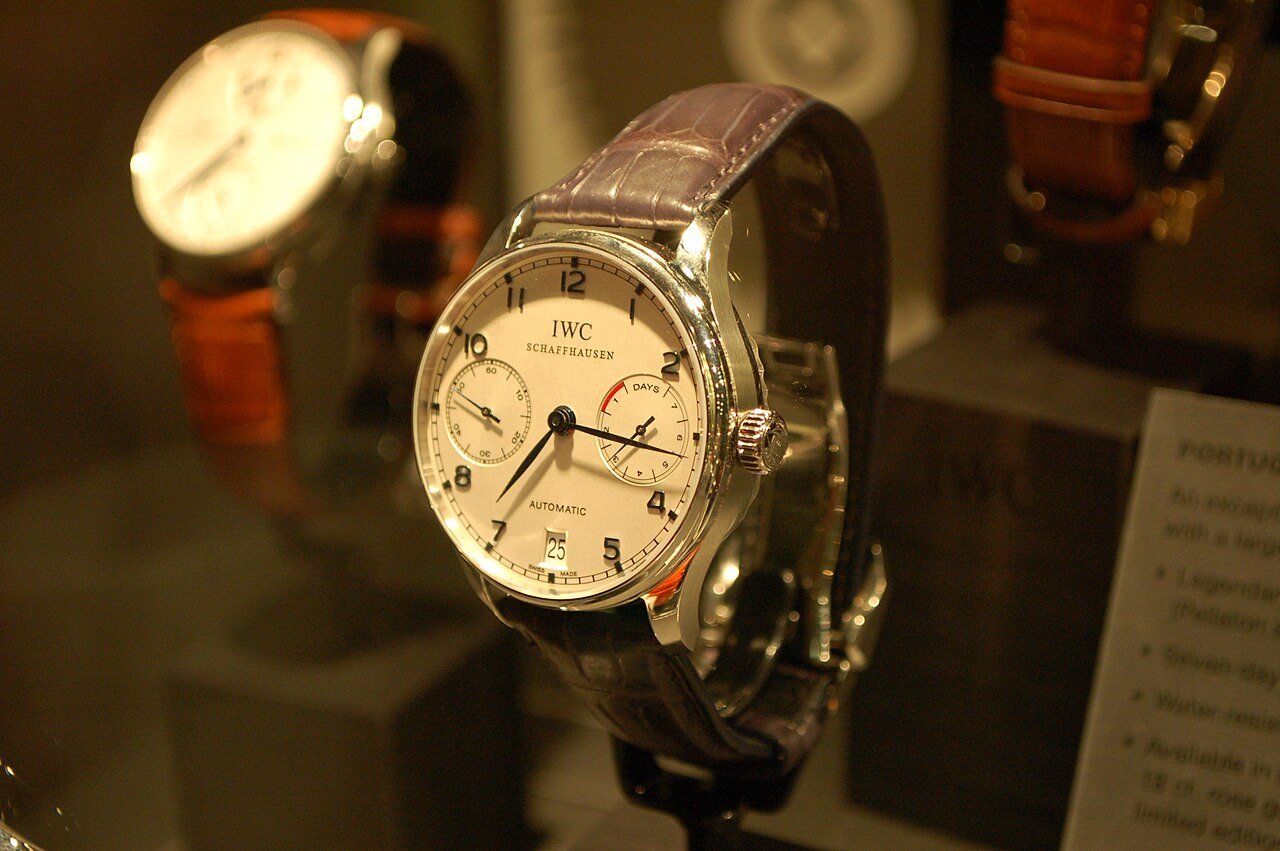
Cover: IWC Portuguese Automatic, Ferengi; CC BY-SA 3.0. Resized by Wikimedia Commons; no other changes by BBE. Compact-delivery image resized and JPEG-compressed; no cropping or content edits.

A seven-day power reserve sounds like a promise that a watch will always be ready after a week away. With a pre-owned IWC Portugieser Automatic, the useful question is more specific: how much energy is stored now, and which reference’s instructions describe the watch in front of you?
The reserve indicator makes that conversation unusually visible. It can help an owner rotate between watches without guessing, provided the claimed duration is understood as a fully wound specification and the individual watch is operating properly.
Begin with the reference
IWC’s archived page for IW500107 identifies a stainless-steel Portugieser Automatic with calibre 51011, a 168-hour reserve and Pellaton automatic winding. Its case measures 42.3 millimeters across and 14.1 millimeters high. Those are specifications for that reference, not universal measurements for every Portugieser.
A later watch can preserve the familiar dial layout while using a different movement. In its September 8, 2017 announcement, IWC described blue-dial reference IW500710 with calibre 52010, ceramic components in the Pellaton winding system and two barrels supplying a seven-day reserve. The announcement is useful historical evidence when comparing pre-owned generations.
Record the full reference before asking about the mechanism. A listing headed simply “Portugieser seven day” leaves important information unresolved, even if its photograph looks familiar.
Read the reserve as a changing display
The reference 5001 operating instructions specify approximately seven days when fully wound. They describe a continuous indicator divided into days and explain that wearing the watch replenishes its reserve through the automatic winding mechanism.
The same manual warns that precision can decline in the marked final-day area and advises manual winding if necessary. For an owner of that reference, the indicator is therefore useful before the watch actually stops. Follow the matching manual rather than carrying that instruction over indiscriminately to another calibre.
Imagine putting the watch away with three days indicated and returning five days later. The seven-day model specification does not describe that starting condition. Conversely, an owner who checks the indicator before switching watches can make a more informed plan for the next wearing.
Ask for a measured condition check
When considering a used example, request service records and ask a qualified watchmaker how its running reserve and timekeeping have been evaluated. Useful documentation states the starting condition, elapsed test period and observations. A seller pointing to a high reserve reading during a short appointment gives you much less information.
Discuss inconsistent winding or an unexpectedly short running period before purchasing. Avoid diagnosing the cause from the dial alone. The reserve display is a helpful observation, but it cannot explain every condition inside the movement.
Make the setting routine familiar
Have the seller demonstrate winding, time setting and date correction using the proper manual. For reference 5001, IWC prohibits rapid date correction between 8 p.m. and 2 a.m., when its automatic date change is operating. Keep those reference-specific instructions accessible after the handover.
The accompanying 2009 photograph shows a Portuguese Automatic with small seconds and a seven-day indicator. Its precise reference is not established by the image’s documentation; it illustrates the layout rather than certifying either reference discussed here.
Finally, try the case and strap on your own wrist. Leave enough time to check cuff clearance and read the reserve naturally. A long-running movement is appealing, but the best example is the one whose proportions, documented condition and everyday routine all suit its next owner.
From the Journal
Grand Seiko Snowflake: Spring Drive in the SBGA011 and SBGA211
Looking for a particular exotic car? Start your private search with Big Boy Exotics or send your car-sourcing brief to info@bigboyexotics.com.